
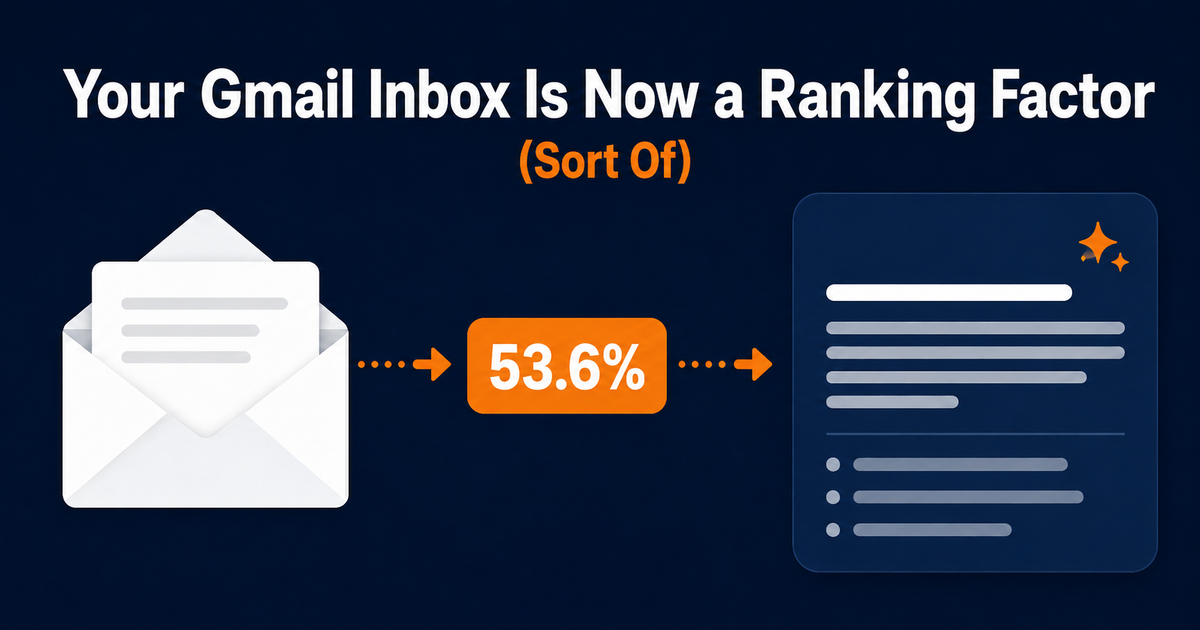
 A new study found that emails sitting in your inbox can change which brands Google’s AI recommends to you. The number is real. The hype around it is not.
You probably got the newsletter. I got three versions of it in one week.
The pitch goes like this: a study proved that brands with emails in someone’s Gmail inbox showed up in 53.6% of Google AI Mode responses. Email is now an AI ranking signal. Your entire strategy needs to change. Conveniently, the person telling you this sells email marketing services.
So I read the actual study. Not the newsletter about the study. The study.
The research is legitimate. The 53.6% is real. And the conclusion most people are drawing from it is wrong in ways that will cost you money if you act on it. Walk through this with me.
What Google Actually Shipped
In January 2026, Google rolled out a feature called Personal Intelligence. When a user turns it on, AI Mode in Search can pull context from their Gmail and Google Photos to shape answers. Ask about coats before a trip and it already knows your destination from the flight confirmation sitting in your inbox. It started as a paid Labs experiment for AI Pro and Ultra subscribers, then expanded to all US users in March.
Two words in that paragraph matter more than everything else you’ll read about this topic today: turns it on. Personal Intelligence is opt-in. Connecting Gmail and Photos to AI Mode is off by default. Every user who sees personalized brand recommendations chose to flip that switch. Keep that in your back pocket. We’re coming back to it.
What the Study Actually Did
The research comes from iPullRank, and credit where it’s due, the design was clean. Three Google accounts: a blank control, a blank account connected to Personal Intelligence, and a mature personal account with years of real history. The team seeded brand signals into the connected account, brand emails into Gmail, brand images into Photos, then ran queries across all three accounts and compared what AI Mode recommended.
They collected 1,922 AI Mode responses over 17 days. The seeded brands in the Personal Intelligence account pulled statistically significant visibility lift against the control. Not a subtle drift, either. The account tracked close to control early in the test, then separated right after the seed events while control stayed flat. That timing pattern makes the result hard to write off as normal AI Mode volatility.
The Numbers That Matter
23.9% → 66.8% brand appearance rate after seeding in the Personal Intelligence account
53.6% appearance rate for brands seeded through Gmail
10.5% appearance rate for brands seeded through Photos
4.5% → 24.9% top-3 placement improvement
17.7% → 54.6% top-10 placement improvement
Gmail wasn’t just a signal. It was the signal. Email seeding beat photo seeding five to one on appearance rate. The brands didn’t just show up more, they moved into better positions. If you stopped reading right there, you’d conclude email is the new backlink. Which is exactly where the newsletter crowd stopped reading.
Four Things the Hype Merchants Skipped
The feature is opt-in and off by default. Nobody outside Google knows what percentage of searchers have actually connected their Gmail to AI Mode. The addressable pool grew when Google opened it to free users in March, but a signal that only fires for users who deliberately enabled a Labs-born feature is not a ranking factor in any sense you’re used to. It’s a conditional bonus for a slice of the audience nobody can size.
Three accounts. Seventeen days. The study’s own authors are upfront about this. It proves the mechanism exists. It does not prove the effect size holds across millions of real inboxes with years of accumulated noise, promotions tabs, and competing brand signals. One clean experiment is a starting gun, not a finish line.
Seeded is not subscribed. The researchers placed specific brand emails into a controlled test inbox. That is not the same as someone joining your newsletter and letting it pile up unread in Promotions. The study tested nothing about open rates, engagement, or whether an ignored email carries the same weight as a read one. Anyone telling you “they don’t even need to open your emails” is inventing a finding the study never made.
Trust-heavy categories barely moved. This is my favorite part. Consumer products like coffee machines, hoodies, and running shoes were easy to influence. Banks resisted. And SEO agencies, the exact category of business blasting this study into your inbox to sell you email services, were among the hardest categories to move. The people pitching you this tactic are citing a study that found the tactic works worst for businesses like theirs. And probably yours, if you sell services instead of sneakers.
The Detail Everyone Buried
Even when personal context influenced which brands appeared, AI Mode still grounded its answers in the open web. Websites belonging to brands that were never seeded into the inbox accounted for roughly 49% of cited sources on their own, before you count the seeded brands’ sites and Shopping listings that also got cited. Personal signals nudged the shortlist. Web authority still built it.
Why the 49% Is the Real Story
Sit with that stat for a second. In an experiment specifically rigged to maximize personal-context influence, with brand emails hand-placed into the inbox and the feature switched on, unseeded websites alone covered nearly half the citations. Add the seeded brands’ own sites and their Shopping listings back in and AI Mode pulled well over half its grounding from the open web. The retrieval layer didn’t go anywhere. Google’s AI reads the web, weighs authority, and cites sources, same as it ever did. Personal Intelligence sits on top of that foundation. It doesn’t replace it.
This is the pattern I keep seeing across every AI search development, and I’ve been tracking these systems closely because my clients’ visibility depends on it. Every new signal gets announced as the death of the old ones. Then you look at the data and the old ones are still doing the heavy lifting. Links are multipliers, not magic, and that hasn’t changed just because the answer box got smarter. A brand with no web authority and a great email list gets nudged onto shortlists it was never going to lead. A brand with real structural authority gets cited whether or not it ever landed in your inbox.
If personal context and web grounding are two lanes, the web lane is still the one you control, the one that works for every searcher instead of the opt-in slice, and the one where the compounding happens.
What I’d Actually Do With This
Keep your email list warm. Not because this study proved email is a ranking factor, it didn’t, but because the cost of consistent inbox presence is low and there’s now early evidence it carries a visibility side effect for the users who’ve opted in. That’s a footnote in your strategy. Write the footnote.
Do not rebuild anything around it. One vendor, three accounts, 17 days, an opt-in feature with unknown adoption, and a demonstrated weakness in exactly the trust-heavy categories where most of my readers operate. If follow-up research replicates the effect and Google keeps loosening the defaults, this gets a promotion from footnote to chapter. Check back in a quarter.
And watch the backlash. Tech press is already framing this as Google turning inboxes into a confirmation-bias machine, and Google never confirmed how any of this weighting works. External researchers measured behavior from the outside. If the echo-chamber criticism gets loud enough, Google can quietly dampen the whole signal tomorrow and owes nobody an explanation. You do not build on ground the landlord can pull out from under you.
Spend the energy where the study says half the game still lives: the open web. Get your brand cited by the sources AI engines actually ground their answers in. Build the authority signals that work for a hundred percent of searchers instead of the opted-in fraction. That work was the right call before this study, and the study’s own data says it’s still the right call after.
Read the studies. Skip the newsletters about the studies. The gap between the two is where bad strategy gets sold.