
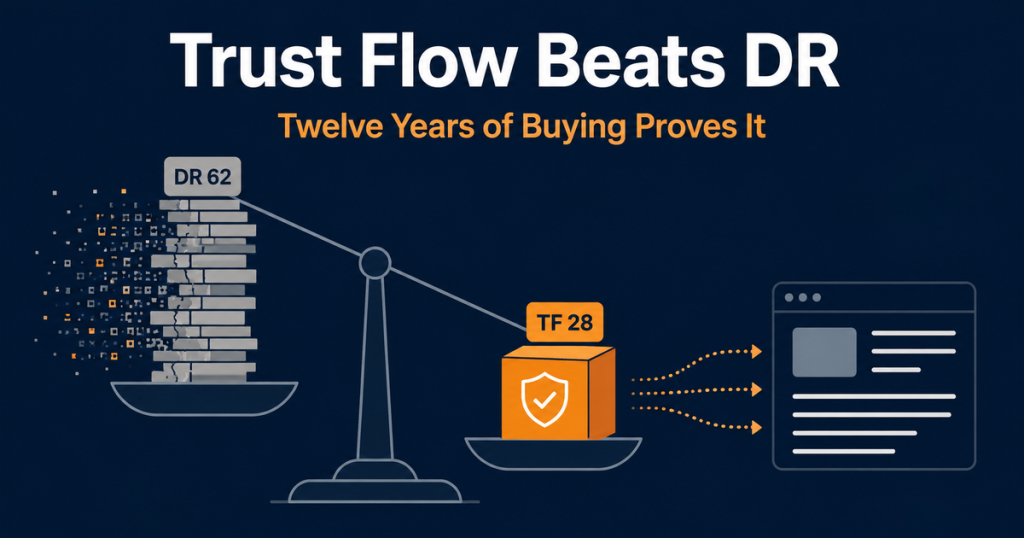
 Somebody sends me a domain to evaluate at least once a week. Nine times out of ten, the pitch leads with Domain Rating. “It’s a DR 62, great pickup.” And nine times out of ten, I pull the Majestic numbers, look at the Trust Flow, and pass.
I’ve been evaluating domains and placements on Trust Flow since 2014. Thousands of buying decisions, twelve years of watching which links actually move rankings and which ones just decorate a spreadsheet. The industry standardized on DR and DA in that time. I didn’t, and the reason isn’t stubbornness. The reason is that two of these metrics can be inflated with garbage for less than a hundred bucks, and the third only moves when real trust flows into a site.
What Trust Flow Measures That DR Doesn’t
The mechanics matter here, so bear with me for a paragraph.
Majestic built Trust Flow on a manually reviewed seed set of sites that are trustworthy beyond argument. Major news organizations, government domains, universities, institutions that don’t sell links and never will. Trust Flow measures how close your links sit to that seed set. A site linked from pages that trace back to trusted sources in a few hops carries high TF. A site linked from a swamp of directories, expired-domain blogs, and comment spam carries almost none, no matter how many links it has.
Domain Rating measures link volume and the DR of the linking domains. That’s it. It’s circular by design: sites with lots of links from sites with lots of links score high. There’s no trust lineage anywhere in the calculation. Quantity feeding on quantity.
Which is exactly why DR became the metric every marketplace seller quotes. It goes up when you point links at it. Any links.
You Can Buy DR. Go Look.
Search any freelance marketplace for “increase DR” and you’ll find pages of sellers offering to push a site to DR 50, 60, 70 for the price of a dinner. They do it with mass-produced links from inflated domains, and it works, in the sense that the number goes up. The trust doesn’t. Run those same boosted domains through Majestic and you’ll find TF sitting in the single digits under a DR in the sixties. The gap between those two numbers is the fraud, quantified.
Now try to find the equivalent for Trust Flow. The gigs barely exist, and the few that actually work cost multiples of the DR ones. Think about why. To move TF you need links from domains that trace back to the trusted seed set, which means whoever’s selling the boost had to own or control genuinely trusted real estate before you ever showed up. You can’t manufacture that with a link blast. I know this firsthand, because I’ve moved Trust Flow for clients, and the only thing that has ever worked is links from clean, genuinely trusted domains. Point spam at a site and TF doesn’t budge. Worse, the junk inflates Citation Flow while adding zero trust, so the blast actively drags your TF/CF ratio in the wrong direction. Trust can’t be counterfeited. It can only be transferred, and transferring it requires holding it first, which is exactly why it never costs forty dollars.
That’s the entire argument. When DR moves, links happened. When TF moves, trust moved. One of those tells you something, and twelve years of results back it up.
How I Read a Domain in 30 Seconds
TF > CF Trust Flow above Citation Flow, or I’m out. Volume without trust is spam velocity
TF 20+ my floor for a domain or placement worth paying for
DR 60 / TF 8 the signature of a boosted domain. The gap is the tell
2014 the year I started buying on TF. Still haven’t found a reason to stop
The Ratio Tells You More Than the Score
Citation Flow is Majestic’s volume metric, roughly analogous to what DR measures. On its own it tells you a site gets linked a lot. Paired with Trust Flow it tells you what kind of linking that is.
TF above CF means the site’s links skew toward trusted sources. Rare and valuable. TF roughly equal to CF means a normal, healthy profile. TF way below CF means somebody’s been blasting. A domain showing CF 45 and TF 12 has a lot of links from places that trust can’t reach, and pointing that at your money site transfers the neighborhood along with the link.
This ratio check is the first thing I run on any domain I’m buying and any site offering placements. It filters out ninety percent of what gets pitched to me before I’ve read a single page of the site. I covered what the bad ones look like up close in an earlier post; the TF/CF gap is how you spot them from orbit.
Where Trust Actually Lives
Follow the logic to its endpoint and you arrive somewhere specific. If trust flows from a seed set of legitimate institutions, then the links worth owning sit on sites those institutions can reach. Real editorial properties. Sites with named authors, editorial standards, a maintained archive, and an outbound link profile that isn’t a used car lot.
Compare that to what the guest post economy actually sells. A DR 55 site that publishes forty sponsored posts a month, links out to casinos and CBD in the same sidebar, and has a TF of 6 because nothing trustworthy has ever linked to it and nothing ever will. The placement is real. The link is live. And it transfers nothing, because there’s no trust on that domain to flow through it.
A placement worth paying for looks different, and you can verify every part of it before spending a dime. Trust Flow 20 or better with TF at or above CF. A clean outbound profile, meaning the site links to normal things at a normal rate. Content that existed before you showed up and keeps getting published after. And permanence. A link that quietly drops off after ninety days when the renewal invoice goes unpaid isn’t an asset, it’s a subscription, and Google watches links appear and disappear the same way you’d watch a tenant who keeps changing the locks.
This is why the editorial placement work I do runs on permanent placements on properties I’ve verified down to the link neighborhood. Not because permanence sounds nice in a sales page, but because trust compounds on links that stay put. Anchor selection matters on top of that, and I’ve written a full breakdown of how I set anchor ratios per page, but the anchor conversation is pointless if the domain underneath it has no trust to give.
The Objection, and Why It’s Backwards
The standard pushback: Google doesn’t use Trust Flow, it’s a third-party metric, so optimizing for it is optimizing for Majestic’s opinion.
Correct, and it misses the point completely. Google doesn’t use DR either. No third-party metric is a ranking factor. The question is which proxy best approximates what Google’s systems actually reward, and Google has spent two decades telling anyone who’d listen that link evaluation is about quality and trust, not raw counts. A metric built on distance-from-trusted-sources models that a lot more honestly than a metric built on link volume recursion. My rankings have agreed with that assessment through every core update Google has shipped since 2014.
The Buying Rules, Compressed
Check the ratio first. TF at or above CF, or walk. The gap between DR and TF is where the fraud hides
Verify the neighborhood. Real authors, maintained archive, outbound links a normal site would have
Pay for permanence. Trust compounds on links that stay. Rented links are a subscription, not an asset
Twelve years from now I expect DR will still be the number on every marketplace listing, because it’s the number sellers can move. And I expect I’ll still be pulling Majestic before I spend a dollar, because the metric that can’t be counterfeited is the one that keeps telling the truth. Buy trust. Everything else is decoration.